
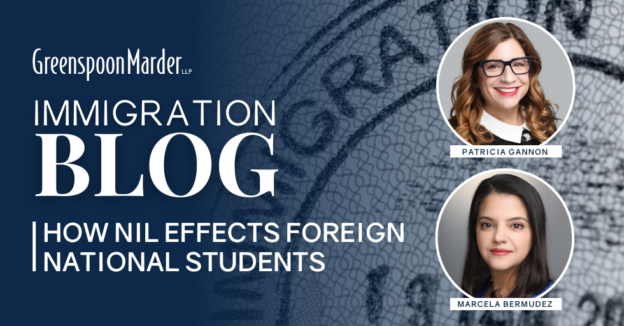
By: Patricia Gannon Esq., and Marcela Bermudez, Esq.
The entire landscape of Name, Image, Likeness, (NIL) has evolved and universities continue to focus resources to donors, brands and students. But there is no clear guidance on how NIL affects foreign national students and what they are allowed to do under immigration rules.
On June 21, 2021, the Supreme Court in NCAA v. Alston invalidated NCAA restrictions on education-related benefits for college athletes. In reaction to this, the Department of Homeland Security’s Student and Exchange Visitor Program (SEVP) indicated that SEVP “is aware of and actively monitoring proposed federal and state legislation pertaining to the use of NIL for student athletes, including F and M nonimmigrant students.”
Since 2021, multiple states have enacted legislation that allows for student athlete NIL compensation, largely modeled on California’s Fair Pay to Play Act (Senate Bill 206) — the first state NIL measure enacted. The expansion of NIL continues but there is little guidance from USCIS for foreign national students. The NCAA has indicated that foreign student athletes can “benefit” from their NIL and has outlined the need for such athletes to consult with their institution as it relates to maintaining their immigration status.
In the absence of guidance from SEVP, colleges and universities, as well as foreign student athletes themselves, lack clarity on what activities are permissible for foreign student athletes to engage in and what activities will lead to a violation of their F-1 student immigration status. An F-1 is allowed to work in particular circumstances. Curricular Practical Training (CPT) is temporary employment authorization that allows F-1 students to work legally off campus. F-1 is a student visa—not a work visa—so F-1 students are normally limited to on-campus employment. To qualify for CPT, the proposed work must be directly related to a student’s major area of study and have a curricular requirement. CPT is only available while a student is pursuing their degree. Once the student completes the degree requirements, a student has to apply for optional practical training. Among other requirements, the employment received must be limited to the student’s field of study. As a result of the current F-1 visa work rules, certain athletes on the same team have vastly different opportunities available to them. Foreign students may be unable to earn a profit from their NIL even if they appear at events like autograph signings and other common events.
Some schools have advised that such athletes may limit their domestic activities to those that generate passive income, meaning that such activities do not require the foreign student-athlete’s active participation and exclude payment for what would be considered “services” or “labor for hire” under U.S. labor laws. This position has not been endorsed by immigration. Permissible activities may include name licensing, group licensing, and other things like billboard advertising. However, it’s a very fine line of what is passive or active income, and it puts foreign student athletes in a very difficult position to decide what choices to make. If they engage in active income, students could be in violation of their immigration status.
As NIL continues to expand, it’s important that NCAA colleges ensure that foreign students and their activity are in line with immigration. There are no clear guidelines from immigration and foreign students need to minimize their risks.
